

Shared meals are a normal part of the dining experience in Germany: according to YouGov, 82% of people who live with others usually eat together, but not always at the dining table. 37% of working people in Germany eat somewhere other than their dining or kitchen table either daily or several times a week because it is already being used for another purpose. That is the finding of an analysis by home24 and DataPulse Research.
But what place do shared meals have in everyday life in Germany? One starting point is the dining or kitchen table: how it is used shows how work, free time and shared meals come together at home.
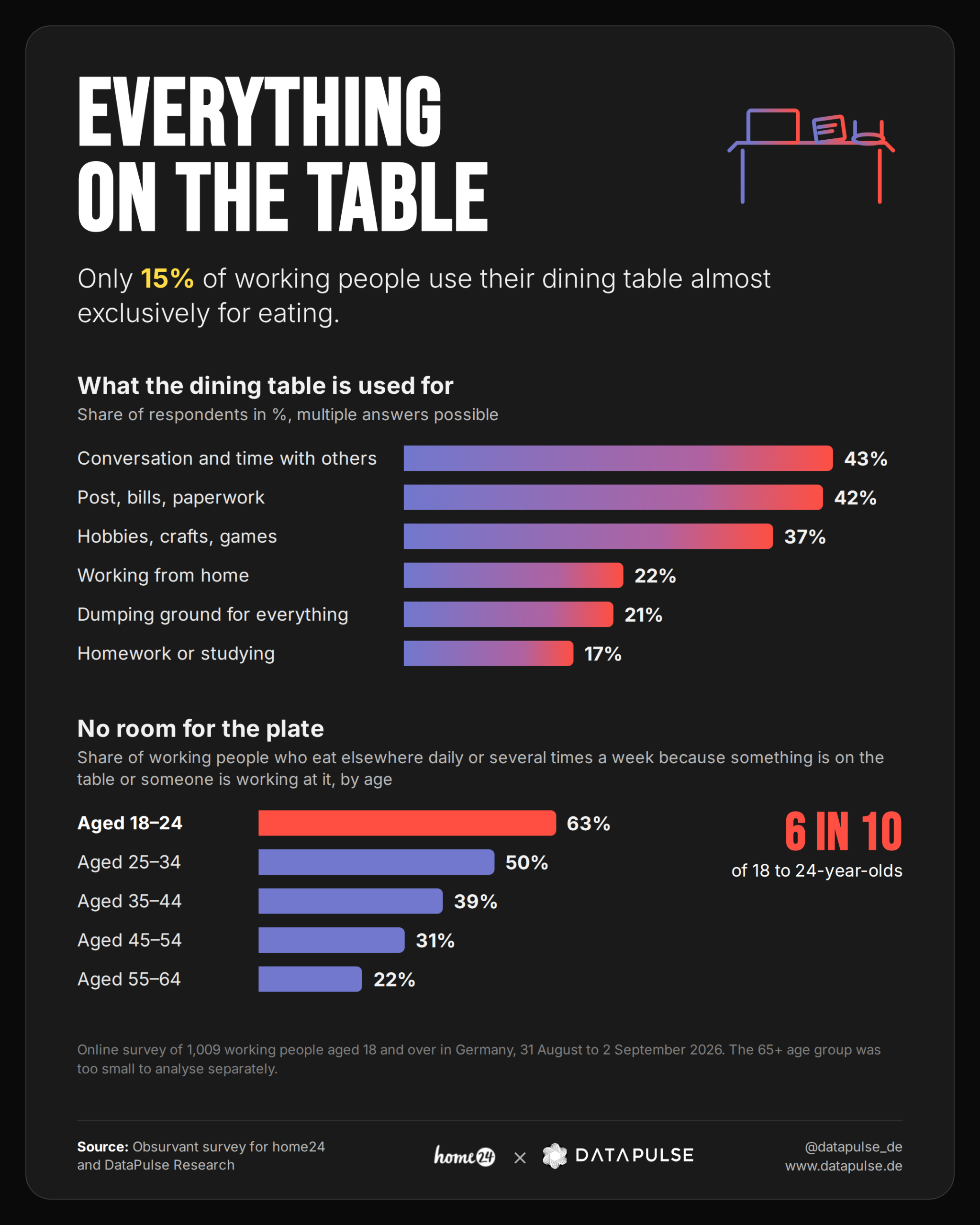
A survey of 1,009 working people in Germany, carried out by home24 and DataPulse Research, shows what the dining table is actually used for. The result: it is far more than solely a place to eat. As the infographic shows, only 15% of people use their dining or kitchen table almost exclusively for eating.
For the vast majority, then, it has to do quite different jobs as well. Even outside mealtimes, the shared table is a social hub: 43% use it for conversation and time with others. Almost as many (42%) do paperwork there, and 37% pursue hobbies, do crafts or play games. And for 21%, it is a dumping ground where everything ends up.
Yet the table still serves its original purpose. Asked about its main use, 45% name eating. For around a third (32%), eating and other uses are evenly balanced, while for just under a fifth (19%), other activities dominate. For more than three-quarters of people, eating is still at least as important as everything else that happens at the table. It is just rarely the only thing.
These uses sometimes get in the way of eating. Every day, 12% of respondents eat somewhere else because something is lying on the table or someone is working at it. Another 25% do so several times a week, bringing the total to 37%.
The trend runs through every age group analysed: the younger the respondents, the more often they eat elsewhere several times a week or daily. The share ranges from 22% among 55- to 64-year-olds to 63% among 18- to 24-year-olds. Younger respondents are also more likely than older ones to use the table as a place to work or study.
The many uses of the dining table also reflect changing work habits. In 2025, just under a quarter of working people in Germany worked from home at least some of the time, up from around 13% in 2019. As a result, work more often finds its way into the home: in the survey for this study, just over one in five use their dining or kitchen table for work as well.
How much room there is for different activities also depends on people's circumstances. According to the 2022 microcensus, households headed by under-25s had an average of around 45 square metres of living space per person, while households of 45- to 64-year-olds had around 55 square metres. Less space per person could be one reason a single table serves multiple purposes. The data does not show whether this also explains why younger respondents more often eat elsewhere.
The fact that the dining table is used for more than eating does not make it any less important. People work, play and eat at the same table, just not always all at once.
It is not only where we eat that shapes our daily eating habits, but also how much time we take for it. On average, people in Germany aged ten and over spend around 100 minutes a day eating and drinking. That figure has barely changed in two decades: it was 103 minutes per day in 2001/02 and 100 in 2022.
Behind the stable average, however, differences emerge: while eating time stayed almost the same among younger and older adults, it fell by nine to twelve minutes a day among 30- to 64-year-olds. The figures cover all time spent eating and drinking, not just shared meals or eating at the table. In midlife in particular, eating seems to take up a little less room in everyday life, at least in terms of time.
Women are the most affected: women aged 30 to 44 have lost 13 minutes a day since 2001/02, men of the same age, nine minutes. The difference is even more marked among parents. By household type, however, only the 2012/13 and 2022 surveys can be compared, so ten years rather than twenty. Even in this shorter period, mothers spent 11 minutes less eating and drinking, whether living with a partner or as single parents. Fathers living with their partner lost three minutes.
It is not just a question of how much time is left for eating; where people eat matters too. A 2024 YouGov survey offers a clue: when eating dinner at home, the dining or kitchen table is the most common spot in Germany, with 66% eating there. One in five usually sits on the sofa or in an armchair.
A cross-country comparison shows how much habits vary: in Italy, 92% eat at the table; in the UK, only 45%. In the UK, the sofa or armchair is almost as common, at 42%. Germany sits between these two extremes: the table remains the main place to eat, but far from the only one.
“Eating no longer happens only at the dining table, and that is reflected in how people furnish their homes. We now even sell more side tables than dining tables, while a trend towards extendable models is emerging at the same time. People want furniture that adapts to everyday life, from a snack on the sofa to a big dinner party,”
Michael Schmidt-Rost, VP Data at home24The fact that most German households eat together is nothing unusual by international standards. As the YouGov survey shows, people come together for meals most often in Denmark (91%), Italy (90%) and France (89%), with Sweden at 88%. Germany, at 82%, sits mid-table, on a par with Spain, the home of the sobremesa, the long conversation after a meal (83%).
It is less common in the UK (78%) and the US (72%). In the US, just over one in four eat separately from the rest of their household; in Denmark, not even one in ten.
Sobremesa, Abendbrot (the traditional German bread supper) or TV dinner: eating habits differ, but the value of shared meals remains. After all, whether at the table or on the sofa, eating together is good for us.
The analysis combines our own survey with official statistics on time use and housing in Germany, and with international survey data from Europe and the US.
Our own survey. From 31 August to 2 September 2026, home24 and DataPulse Research surveyed a total of 1,009 working people in Germany about how they use their dining or kitchen table: whether it is used mainly for eating or for other things, what activities take place there apart from eating, and how often people eat somewhere else because the table is taken. The online survey was carried out by Obsurvant and stratified by gender and region. Age breakdowns refer to the groups 18 to 24 (n = 104), 25 to 34, 35 to 44, 45 to 54 and 55 to 64. The 65-and-over group was too small to analyse separately.
Time use in Germany. The figures on time spent eating and drinking come from the Time Use Surveys conducted by Germany's Federal Statistical Office (Destatis) in 2001/02 and 2022. Participants record their activities in a diary in ten-minute intervals. The figures show the average time per person per day spent on “eating and drinking” as a main activity. The overall average refers to people aged ten and over, the age comparison to adults aged 18 and over. Children and teenagers were excluded from the age comparison because the age groups differ between the surveys. The figures for 2001/02 come from Destatis's official comparison tables. The comparison by gender also refers to adults aged 18 and over. The figures for mothers and fathers refer to women and men in couple households with children and to single parents. By household type, comparable figures are only available for the 2012/13 and 2022 surveys, so this comparison covers ten years rather than twenty.
Where and with whom people eat. The country comparisons come from a 2024 YouGov survey in 12 countries. The figures on eating together refer to people who live with others; the figures on where people eat refer to dinner at home.
Living space. The figures on living space per person by age of the main income earner, meaning the person with the highest income in the household, come from the 2022 microcensus by Germany's Federal Statistical Office.
Working from home. The figures on the share of working people aged 15 and over who work from home at least some of the time come from Germany's Federal Statistical Office and refer to 2019 and 2025.
Shared meals and wellbeing. World Happiness Report 2025, chapter “Sharing meals with others”.


